Book Review: Unlearning Ableism
By Jamie Shields and Celia Chartres-Aris
Published: 2025
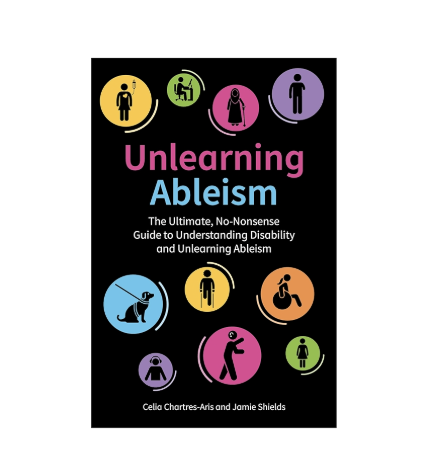
I’ve been thinking about how to write this book review for a few days. Because its overall message and purpose is so important I am loathe to say anything critical about it. On the other hand, I think there can be some good conversations around this book that won’t always be smooth and easy, and I think that perhaps was part of what the authors were after. Well, I will express my thoughts and hopefully it doesn’t rub anyone too far the wrong way.
First things first, I listened to the audio version instead of reading the book, and I think this book would be a better experience if if you read it for yourself. There were two main issues I had with the audiobook. First, there are a lot of great stories from other people with disability in the book, but because the same narrator reads the book throughout, it took me awhile to understand or absorb that these stories were coming from other people and not one of the authors. Each of these sections is introduced as a living with disability experience, but I would have benefited from a bit more of a cue that this was an external perspective to the authors. The other issue, which speaks to one of the strengths of the book, is that there is so much great information it’s hard to really grab everything when listening. I wanted to underline things for future use. That could just be a me problem, however.
The biggest issue I had with the book is that it felt like the readers/listeners without disability were being bullied more than taught. If you are a disabled person, the book is great because it has a kind of “ra ra amen” feel. However, if the goal was to educate people without disability and help them be better allies, I feel like the book may have come off as overwhelming.
Take, for example, the section on employment. It was a LOT of “do not xyz.” Do not indicate that weight needs to be lifted because that can leave out someone with a disability. Do not list good verbal skills because that could leave someone with a disability feeling like they don’t have a chance. The list was long. I understand the perspective of this of course, but on the other hand, employers cannot possibly allow for every possible disability in their listings, and there are some jobs that it would just be incredibly difficult for people to do. For example, if the NBA was posting a position for basketball players, I would not apply because I’m 4’5. It would be incredibly difficult, maybe impossible, for me to get around 7-foot-tall players, not mention shooting the ball from 90 feet away. I don’t feel offended by that. Basketball is something I can’t do. I’m not deprived by that or betrayed. I don’t need the NBA to create accommodations so that people with dwarfism can play. It’s something that is not a good match for me.
There are things, of course, that employers should be willing to do. If they hire you and discover your wheelchair doesn’t fit through the aisles in the office, they should help you with that. My workplace got me a footstool so I can be more comfortable at my desk. There is certainly plenty to criticize when it comes to the hiring process, the interview process, and the job posting process. However, if you list everything “thou shalt not do,” then you say, “Hey, don’t be afraid to talk to us,” I feel like that’s unrealistic. I’m in the disability community myself and found myself getting frustrated by the laying down of rules that you either follow or risk getting labeled as “ableist.”
This dichotomy of “don’t don’t don’t but feel free to ask questions but not like that” ran through the book. I found it frustrating. Start with some basics. Why are certain words derogatory? Why are certain actions ALWAYS rude? I worry we are tying ourselves up with words when there are much bigger problems out there like access, under-hiring, and more. What makes it harder is the disability community doesn’t agree on verbiage. In fact, the subset of people with dwarfism doesn’t agree on verbiage. How can someone not immersed in these issues have a chance?
There is a lot of strong information, all cited, in this book. The personal stories make everything more real. However, listening often made me feel irritated, confused, or hopeless. If I was a person without a disability I would find the depth of information about what not to do entirely overwhelming.
Like the authors say, and others say, one disabled person is one disabled person. I don’t claim to speak for all people in the dwarfism community, not to mention the disability community. For me, however, the book was not what I was hoping for.